
Shrink-wrapping problems usually show up as poor seals, uneven shrinking, film tearing, product movement or inconsistent output. Most can be traced to incorrect settings, film handling, sealing components or shrink-tunnel conditions.
For operators and production teams, the key is to identify the symptom first and then check the relevant part of the machine.
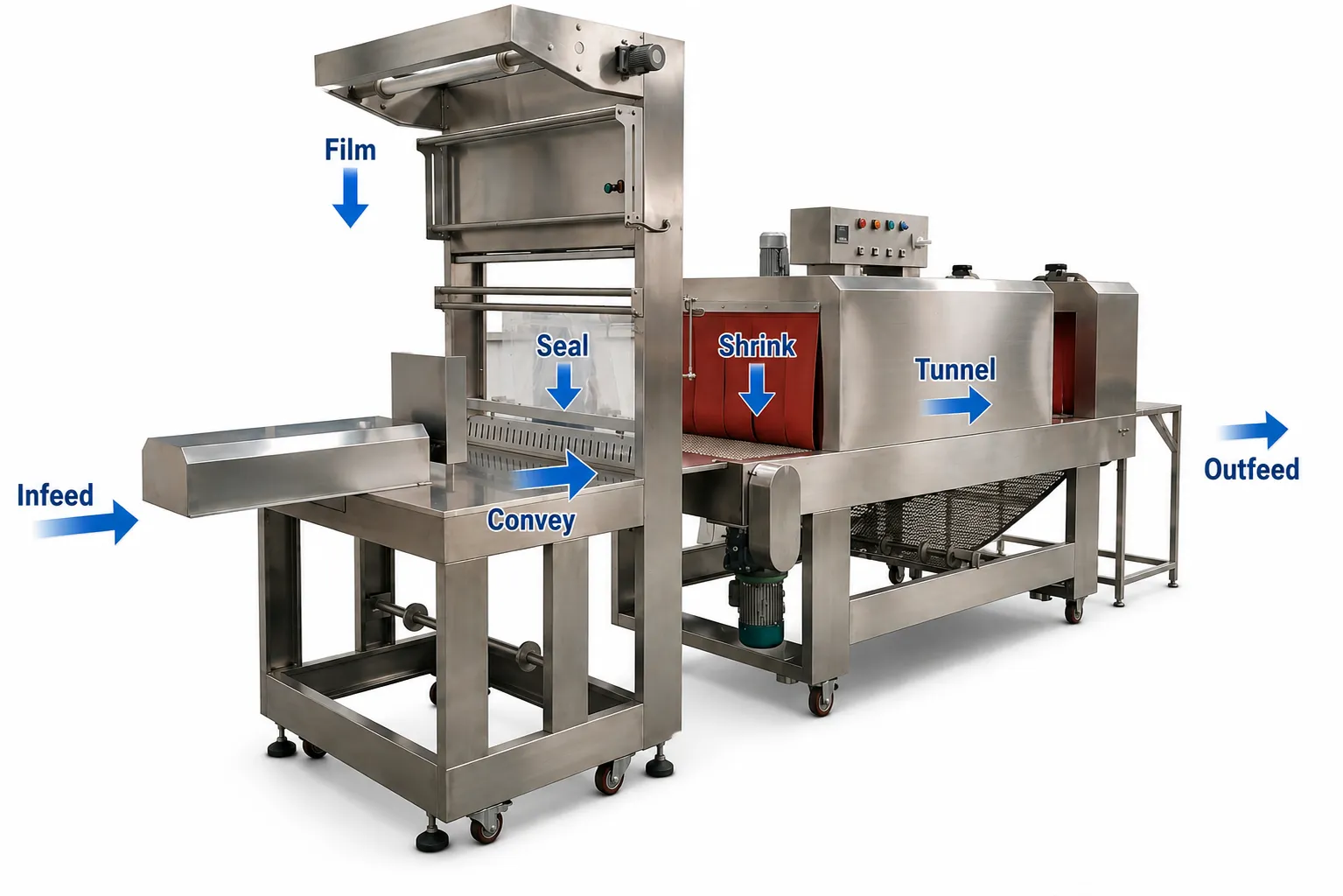
1. Film Is Tearing During Wrapping
Possible causes:
- Film tension is too high
- Film is incorrectly positioned
- Film is damaged or unsuitable
- Product has a sharp edge
- Film roll is not feeding smoothly
What to check:
Check the film path from the roll through the guides and sealing area. Make sure the film is correctly aligned and not being pulled excessively.
If tearing continues, check the film thickness and suitability for the product.
2. Poor or Incomplete Seal
A weak, open or inconsistent seal is one of the most common shrink-wrapping problems.
Check:
- Sealing temperature
- Sealing pressure
- Sealing time
- Sealing blade/element condition
- Film alignment
- Film residue on the sealing surface
If film is sticking to the sealing element or the seal varies from pack to pack, clean and inspect the sealing area before changing machine settings.
3. Film Is Not Shrinking Properly
If the film remains loose or has excessive wrinkles after passing through the tunnel, check:
- Tunnel temperature
- Conveyor speed
- Air circulation
- Film specification
- Product orientation
- Tunnel loading
Increasing temperature is not always the correct solution. Temperature and conveyor speed need to be balanced for the particular film and product.
4. Film Is Over-Shrinking or Burning
If the film becomes excessively tight, develops holes or shows burn marks:
- Temperature may be too high
- Conveyor speed may be too slow
- Airflow may be incorrectly adjusted
- Film may not be suitable for the selected tunnel conditions
Reduce the heat or increase conveyor speed gradually and check the result.
5. Wrinkles Remain on the Package
Some wrinkles are normal depending on the product and film, but excessive wrinkles may indicate:
- Incorrect film size
- Poor film positioning
- Incorrect temperature
- Incorrect conveyor speed
- Uneven airflow
- Product movement during shrinking
Check the film dimensions first. Using more heat will not necessarily solve a film-sizing or positioning problem.
6. Product Moves or Falls During Wrapping
This is particularly important for lightweight cartons, empty bottles and unstable multipacks.
Check:
- Infeed spacing
- Conveyor speed
- Product guides
- Grouping arrangement
- Transfer points
- Product stability before sealing
At higher speeds, the feeding and grouping system must maintain consistent product positioning.
7. Film Is Not Feeding Correctly
If the film is slipping, wandering or feeding unevenly, inspect:
- Film roll installation
- Film guides
- Rollers
- Film tension
- Alignment
- Drive components
Also verify that the film roll dimensions are suitable for the machine.
8. Shrink Quality Changes During Production
If the first packs look good but quality changes after continuous operation, check for:
- Temperature fluctuations
- Blocked airflow
- Film roll changes
- Conveyor speed variation
- Heating-element performance
- Product-size changes
Consistent shrink quality requires stable operating conditions throughout the production run.
9. Machine Speed Is Lower Than Expected
If the machine is not achieving the expected output, don’t immediately increase the speed setting.
Check:
- Product feeding
- Product spacing
- Sealing cycle
- Film feeding
- Conveyor speed
- Tunnel capacity
- Product configuration
The complete packaging line determines practical output. A shrink wrapper may have a high rated speed but cannot maintain that output if feeding or tunnel capacity becomes the bottleneck.
10. Frequent Sensor Errors
For automatic machines, repeated sensor faults can interrupt production.
Check:
- Sensor alignment
- Sensor cleanliness
- Product detection
- Wiring and connections
- Sensor settings
- Obstructions
If the problem repeatedly returns after adjustment, the sensor or associated wiring should be inspected by qualified maintenance personnel.
Quick Troubleshooting Table
| Problem | First Things to Check |
|---|---|
| Film tearing | Film path, tension, alignment, film specification |
| Poor seal | Temperature, pressure, sealing element, film residue |
| Loose shrink | Temperature, conveyor speed, airflow |
| Burned film | Temperature, conveyor speed, film suitability |
| Excessive wrinkles | Film size, positioning, temperature, airflow |
| Product movement | Guides, spacing, conveyor and grouping |
| Uneven film feeding | Roll installation, guides, tension |
| Inconsistent shrink | Temperature, airflow, conveyor speed |
| Low production speed | Feeding, sealing cycle, tunnel capacity |
| Sensor faults | Alignment, cleanliness, wiring |
When Should You Stop the Machine?
Do not continue production if you notice:
- Damaged electrical components
- Exposed wiring
- Repeated overheating
- Abnormal mechanical noise
- Damaged safety guards
- Repeated sealing failures
- Uncontrolled temperature
- A safety sensor or emergency stop not functioning correctly
Electrical and safety-related faults should be handled by qualified personnel.
Prevent Problems Instead of Fixing Them
Many shrink-wrapping problems can be reduced through simple preventive maintenance:
- Keep the film path clean
- Inspect sealing components regularly
- Clean sensors
- Check conveyor alignment
- Maintain the shrink tunnel
- Monitor temperature and conveyor speed
- Replace worn components before failure
- Use the correct film specification
For Metson Machines, proper machine operation and preventive maintenance should be based on the specific machine configuration and operating conditions.
Need Help Identifying a Shrink-Wrapping Problem?
When contacting Metson Machines, provide:
Machine model + product size + film type/thickness + production speed + problem description + photo/video of the package
This allows the technical team to identify the likely cause more quickly and recommend the appropriate adjustment or maintenance action.
If you are facing a recurring shrink-wrapping problem, don’t compensate by continuously changing temperature or speed. Identify the actual cause first—because the right setting depends on the machine, film and product combination.