
A packaging machine rated at 250 BPM does not automatically give you 250 packs per minute in production.
At high speeds, the entire line has to be designed around the required output. Product feeding, spacing, machine cycle time, sealing, film handling, discharge and downstream equipment all have to remain synchronized.
This is where high-speed packaging-line planning becomes different from simply purchasing a higher-speed machine.
At Metson Machines, we look at the complete production requirement before determining the appropriate machine speed and configuration.
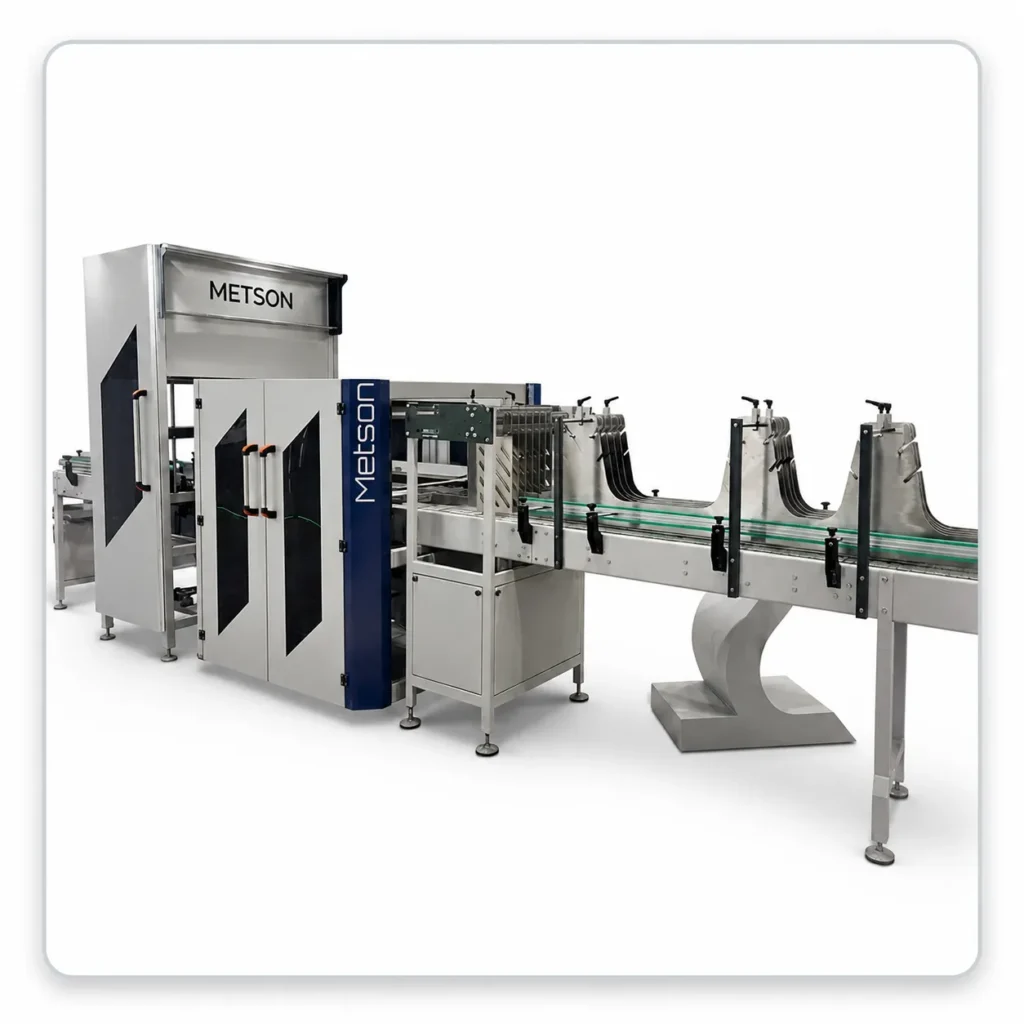
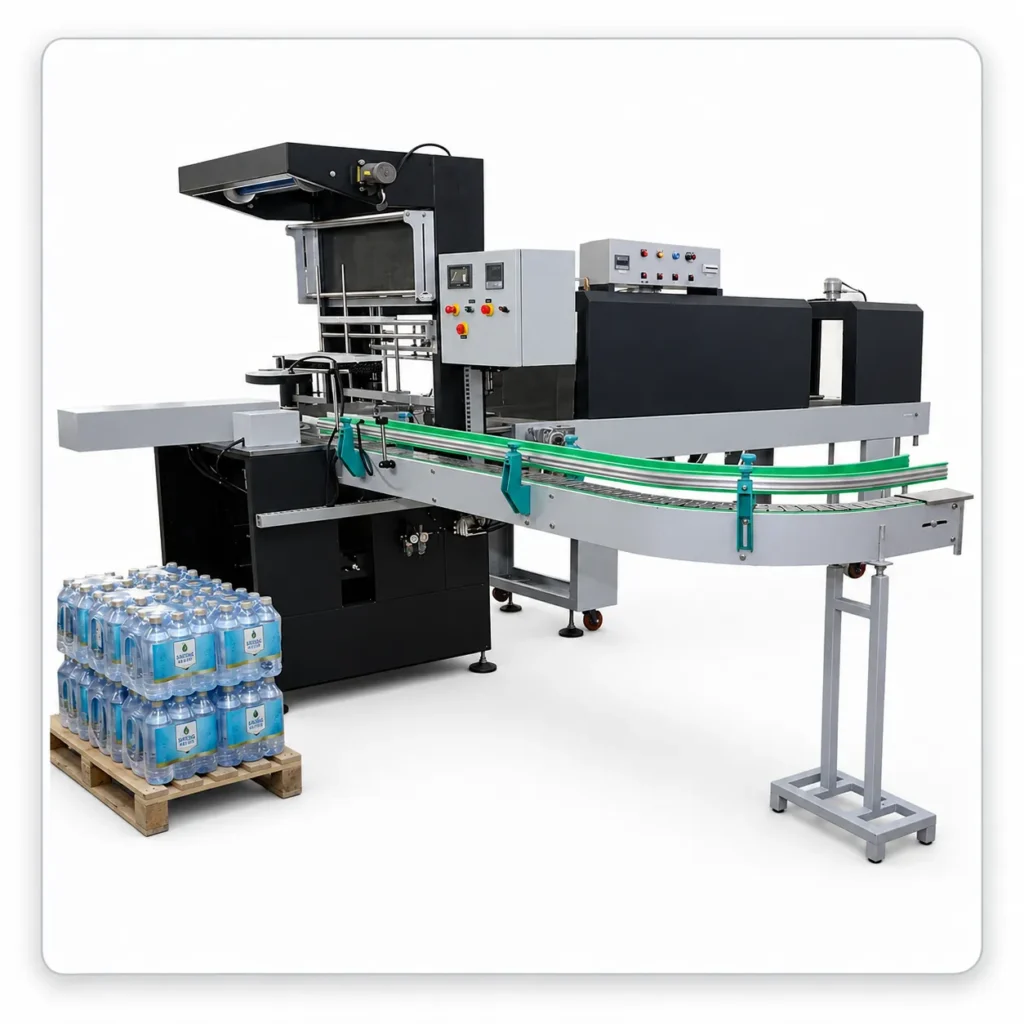
Start With the Number That Matters: Packs Per Hour
Before specifying a machine, establish your actual finished production requirement.
For example:
12,000 packs/hour
Convert this into the required theoretical speed:
12,000 ÷ 60 = 200 BPM
Now you have a starting point.
But don’t immediately specify a 200 BPM machine.
You need to determine whether the line can continuously feed, package and discharge products at that rate.
Example Production Targets
| Required Output | Theoretical Speed |
|---|---|
| 6,000 packs/hour | 100 BPM |
| 9,000 packs/hour | 150 BPM |
| 12,000 packs/hour | 200 BPM |
| 15,000 packs/hour | 250 BPM |
These numbers describe theoretical throughput. Actual sustainable production depends on the complete line.
The First Engineering Question: What Is the Product?
High-speed packaging starts with the product—not the machine.
Metson needs to know:
- Product length
- Product width
- Product height
- Product weight
- Product shape
- Product orientation
- Product rigidity
- Product surface
- Pack dimensions
- Number of products per pack
- Required pack configuration
A small, rigid, uniform product can be handled very differently from a large, flexible or irregular product.
A machine speed that is practical for one product may not be appropriate for another.
Calculate the Machine Cycle
At high speed, the available cycle time becomes very small.
At 100 BPM:
60 ÷ 100 = 0.60 seconds/pack
At 150 BPM:
60 ÷ 150 = 0.40 seconds/pack
At 200 BPM:
60 ÷ 200 = 0.30 seconds/pack
At 250 BPM:
60 ÷ 250 = 0.24 seconds/pack
This is why high-speed packaging is an engineering problem.
At 250 BPM, the line has only about 0.24 seconds per pack at the theoretical cycle level.
That affects:
- Product feeding
- Product spacing
- Film positioning
- Sealing
- Cutting
- Product transfer
- Discharge
The machine has to perform each operation within the available cycle.
Feeding Becomes a Major Bottleneck
One of the first questions we ask is:
How is the product going to enter the machine?
There is a major difference between:
Manual loading → Packaging machine
and
Automatic feeder → Product spacing → Packaging machine
At 100 BPM, an operator may be able to manage certain applications depending on the product.
At 200–250 BPM, manual feeding may become impractical for many applications.
The feeder must continuously provide:
Correct product + correct orientation + correct spacing + correct timing
If any one of these fails, the packaging machine may stop or reject the product.
Product Spacing Is Critical at 200–250 BPM
At 200 BPM, the line processes approximately 3.33 packs per second.
At 250 BPM, this increases to approximately 4.17 packs per second.
The products therefore need to arrive at the packaging point at precisely controlled intervals.
This is why high-speed lines may require properly designed:
- Infeed conveyors
- Metering conveyors
- Timing belts
- Product separators
- Counting systems
- Automatic feeders
The exact solution depends on the product.
Don’t Design the Line Around the Packaging Machine Alone
A high-speed line may look like:
Product Feeding → Product Counting / Separation → Infeed Conveyor → Packaging Machine → Sealing → Inspection / Coding → Discharge
Every section has to support the required throughput.
For example:
| Equipment | Rated Capability |
|---|---|
| Feeder | 250 BPM |
| Infeed | 250 BPM |
| Packaging machine | 250 BPM |
| Sealing | 250 BPM |
| Inspection | 180 BPM |
The line cannot realistically deliver 250 BPM continuously if the inspection stage becomes a 180 BPM bottleneck.
The slowest critical process can determine the practical line output.
Film Selection Becomes More Important at High Speed
At higher production speeds, film handling cannot be treated as an afterthought.
The machine may need to manage:
- Film width
- Film thickness
- Film roll diameter
- Film feeding
- Film tension
- Sealing characteristics
- Cutting
- Film tracking
The selected film must also suit the product and required package.
For a high-speed application, we evaluate the machine + product + film combination, rather than specifying the machine independently.
Sealing Has to Keep Up With the Line
At high speed, there is less time available for each sealing operation.
The sealing system needs to provide consistent:
- Temperature
- Pressure
- Contact
- Seal position
- Cutting
- Package appearance
If the sealing system becomes the limiting process, increasing the infeed speed will not increase finished output.
This is particularly important when evaluating machines based only on their maximum BPM.
100 BPM, 150 BPM, 200 BPM or 250 BPM?
The correct speed should come from the production requirement.
100 BPM
Theoretical output:
6,000 packs/hour
Suitable for applications where production requirements are moderate and the product and feeding arrangement support this rate.
150 BPM
Theoretical output:
9,000 packs/hour
A useful range for applications requiring higher throughput without necessarily moving to the highest-speed configuration.
200 BPM
Theoretical output:
12,000 packs/hour
At this level, feeding, product spacing and line synchronization become increasingly important.
250 BPM
Theoretical output:
15,000 packs/hour
This is a high-speed application where the complete system needs to be engineered around the required cycle.
Don’t Buy 250 BPM If You Only Need 100 BPM
Higher speed sounds better, but it isn’t automatically better for every factory.
If your required production is:
5,000 packs/hour
your theoretical requirement is:
5,000 ÷ 60 = 83.3 BPM
Purchasing a 250 BPM system solely because it has a higher maximum speed may not be the most appropriate approach.
Instead, evaluate:
Required output + product + feeding + operating hours + future production
This gives a more meaningful machine specification.
But Don’t Design Too Close to the Limit Either
The opposite mistake is specifying a machine exactly at today’s required output with no consideration for production variation or future requirements.
Suppose the factory requires:
10,000 packs/hour
The theoretical requirement is:
10,000 ÷ 60 = 166.7 BPM
A machine operating permanently at its absolute maximum may leave little room for:
- Product variation
- Short interruptions
- Film changes
- Adjustment
- Future production increases
The final machine speed should therefore be established from the complete production requirement.
What Metson Needs Before Designing the Line
For a serious high-speed packaging enquiry, these are the details that matter.
Product
- Product photograph
- Product dimensions
- Product weight
- Product shape
- Product material
Packaging
- Current pack size
- Required final pack
- Film type
- Film width
- Products per pack
Production
- Current packs/hour
- Required packs/hour
- Working hours/day
- Number of shifts
- Expected future production
Automation
- Manual feeding
- Semi-automatic feeding
- Automatic feeding
- Existing conveyor
- Existing upstream equipment
- Existing downstream equipment
With this information, the machine can be evaluated against the actual production process.
A Practical Example
Consider a manufacturer producing:
10,000 packs/hour
Required theoretical speed:
10,000 ÷ 60 = 166.7 BPM
The project should not stop at selecting a machine rated at 167 BPM.
The next questions are:
Can the feeder supply approximately 167 products/minute?
Can the product be consistently spaced?
Can the packaging machine maintain the required cycle?
Can the sealing system operate at the required rate?
Can the discharge system handle the finished packs?
What happens during film changes and product changeovers?
These questions determine whether the packaging line will actually deliver the required production.
High-Speed Packaging Is a Line-Design Problem
The machine is only one part of the system.
A successful high-speed line requires coordination between:
Product → Feeding → Spacing → Packaging → Sealing → Inspection → Discharge
If one stage is poorly matched, the machine’s maximum BPM becomes largely irrelevant.
That is why Metson Machines evaluates the complete application before recommending machine speed and configuration.
Planning a 100–250 BPM Packaging Line?
If you are planning a new packaging line or upgrading an existing machine, send Metson Machines:
Product photo + product dimensions + product weight + pack configuration + required packs/hour
We can then evaluate the appropriate:
- Machine speed
- Feeding arrangement
- Conveyor configuration
- Packaging configuration
- Sealing system
- Automation level
- Line capacity
Talk to Metson Machines
Planning a high-speed packaging line?
Send your product and production requirements to Metson Machines for a machine configuration discussion.